An intra-Community supply is a cross-border supply of goods between two EU Member States. If the statutory requirements are met, the supply is not subject to VAT in the seller's Member State. The buyer generally accounts for VAT in the country of destination as an intra-Community acquisition.
Example:
An Italian company sells goods to a German company and transports them to Germany. If all the requirements are met, the Italian seller issues an invoice without Italian VAT. The German buyer accounts for VAT on the acquisition in Germany.
Requirements for VAT Exemption
For a supply to qualify for VAT exemption, the following requirements must be met:
- Business transaction: As a general rule, both the seller and the buyer must act in the course of their economic activities (B2B).
- Valid VAT identification number: Both the seller and the buyer must have a valid VAT identification number. The validity of these numbers can be checked through the VIES system (VAT Information Exchange System).
- Movement of goods within the EU: The goods must actually be transported or dispatched from one EU Member State to another.
- Proof of transport: The seller must retain suitable documents evidencing the transport, such as transport documents, shipping confirmations or proof of receipt.
Invoicing and Reporting Obligations in Italy
Although the fundamental requirements for intra-Community supplies are harmonised across the EU, invoicing and related reporting obligations are also governed by national rules. For businesses in Italy, electronic invoicing through the SDI system and Intrastat declarations are particularly relevant.
A distinction must be made between selling goods from Italy to another EU Member State and purchasing goods from another EU Member State for delivery to Italy.
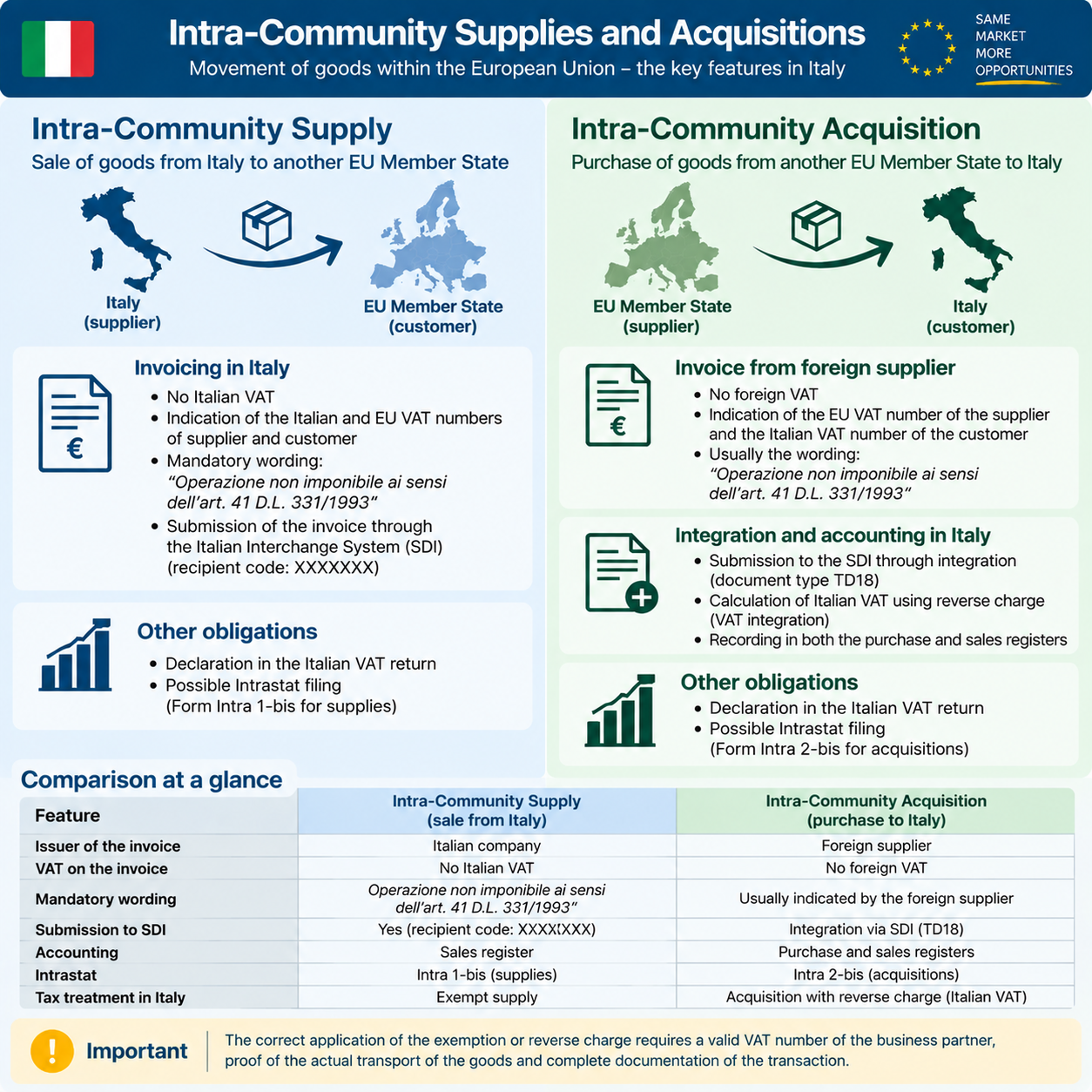
1. Intra-Community Supplies (Sales from Italy to Another EU Member State)
The following requirements apply to a VAT-exempt intra-Community supply:
- The invoice must include the VAT identification numbers of both the seller and the buyer.
- The invoice is issued without Italian VAT.
- The invoice must include the following wording: “Operazione non imponibile ai sensi dell’art. 41 del D.L. 331/1993”.
The electronic invoice is transmitted through the Italian electronic invoicing system, SDI (Sistema di Interscambio). The recipient code “XXXXXXX” is generally used for a foreign recipient.
An Intrastat declaration (Form Intra 1-bis) must also be submitted.
2. Intra-Community Acquisitions (Purchases from Another EU Member State into Italy)
The following requirements apply to an intra-Community acquisition:
- The invoice must include the VAT identification numbers of the supplier and the Italian buyer.
- The foreign supplier's invoice is generally issued without foreign VAT.
The Italian recipient must account for the invoice for VAT purposes in Italy by applying Italian VAT under the reverse-charge mechanism. For this purpose, an electronic integration document must be transmitted through the Italian SDI (Sistema di Interscambio) system, using document type TD18, which applies to intra-Community purchases of goods.
An Intrastat declaration (Form Intra 2-bis) must be submitted for intra-Community purchases of goods if the applicable thresholds are exceeded.